Wednesday, October 21, 2009
Is the Ludovico Technique Moral?

Tuesday, October 20, 2009
Ludvig van Beethoven. Similarly to the promises of John B. Watson in 1913 that investors could be forced into new habits through associations of certain objects with certain end results, the government in A Clockwork Orange try to force Alex's brain to associate rape and violence with his artificially induced sickness, promising a new era of peace and non-violence (narrated all in a first for movies!).
Monday, October 19, 2009
Conditioning of the Human Mind
In this video, Alex is shown being conditioned by being forced to watch gruesome scenes of violence, similar to what he had done before. By making him watch these videos until he says he's feeling sick forces him to associate violence with nausea. After this occurs, the drug begins to affect him. This drug causes severe paralysis and terror, which add to the negative associations of violence.
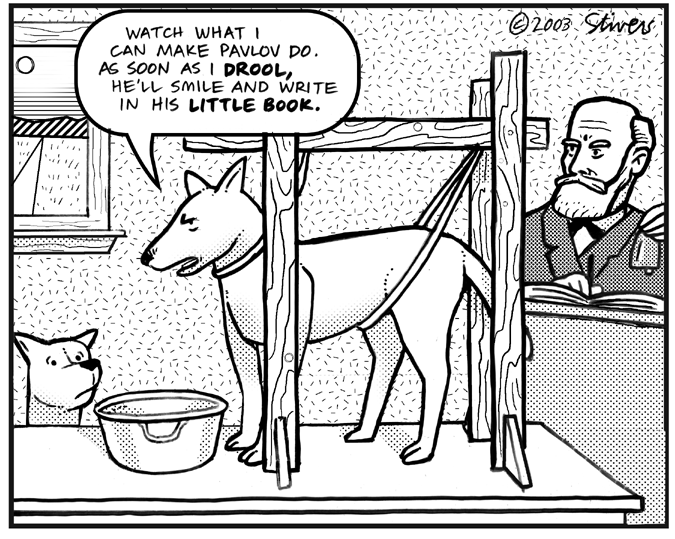
Alex's "treatment" pretty much turns him into one of Pavlov's dogs, in the sense that he responds predictably when confronted with conditioned events. Pavlov's dogs were trained to salivate in reaction to the stimulus of hearing a bell ring. This is because they "learned" that when they hear the bell they will receive food, so their bodies begin salivating. This is similar to how Alex is conditioned, but instead of being trained to a positive reaction, he is trained to be repelled from violence.
However, the mind is very plastic; it can be trained to act a certain way, and as easily as it was trained it can untie the connections. Just as Alex is "cured" from his treatment.
Associative Learning in "A Clockwork Orange"
In the movie "A Clockwork Orange", Alex saw the treatment in prison as an opportunity to escape the walls of the jail and back into society. Instead, the doctors made Alex a prisoner within himself. Once the doctors had control of Alex they conditioned him however they pleased by using associative learning. The doctors were able to train Alex to force a connection between nausea and any malicious activity. So, whenever Alex thought about violence or the "old in-out" he was immediately struck with a feeling of complete sickness (http://www.youtube.com/watch?v=P-JAhY6eT3c ). This is similar to Pavlov's experiments with dogs. Through a series of trials Pavlov trained dogs to salivate whenever a bell was sounded. He did this by associating a bell with eating. Whenever a bell was sounded the dogs would get food. Alex's treatment was much more harsh and included drugs that forced him to be sick. His whole life before the treatment was based in sex and violence and when they were taken away from him he had nothing else to turn to, not even his family.
Classical Conditioning in Grandma's Birthday Cards AND A Clockwork Orange?
BEFORE "CONDITIONING":
The Unconditioned Stimulus, or Pavlov's term for something that initiates an automatic response was the birthday cards in the mail, and the Unconditioned (automatic) Response was happiness because it always feels nice to get a card on your birthday, especially from your grandma.
DURING "CONDITIONING":
AFTER "CONDITIONING":
Now, after many years and many birthday cards from Grandma, every time they receive any letter in the mail, the Conditioned Response of super happiness is initiated.
---------------------------------------------------------------------
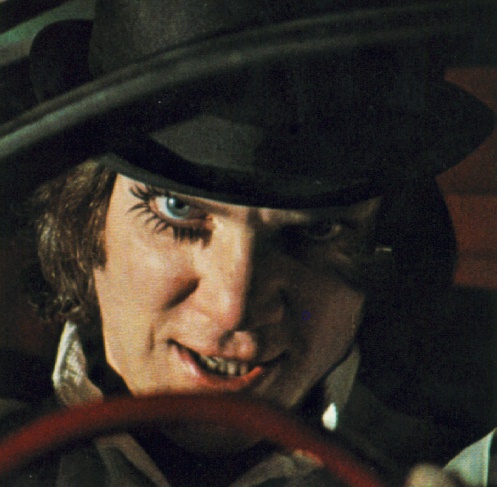
In the famous movie A Clockwork Orange, a young man Alex leads a hedonistic lifestyle without regards for the rules of society, raping women and robbing homes. Eventually though, he is caught for murdering a woman, and is sent to jail. In order to shorten his sentence, Alex persuades his superiors to let him participate in an experimental trial called the Ludovico treatment. The underlying idea of the Ludovico treatment is Pavlov's classical conditioning.
BEFORE "CONDITIONING":
SEXUAL AND/OR VIOLENT IMPULSES

Before Alex was jailed, when Alex was confronted with violent and sexual impulses, the Unconditioned Stimulus, he automatically followed through with these impulses and committed violent and sexual acts, the Unconditioned Response.
(The medicine used in the Ludovico Technique is also an Unconditioned Stimulus, and when someone is given this "medicine," their body will have an Unconditioned Response of extreme nausea.)
DURING "CONDITIONING":

During the Ludovico treatment, Alex was repeatedly shown many images of violence and rape, which would usually create a sense of happiness in Alex. However, each time that he saw these images Alex was also given the medicine, the Conditioned Stimulus, which caused him to be almost physically paralyzed with an overall feeling of nauseousness.
AFTER "CONDITIONING":
SEXUAL AND OR VIOLENT IMPULSES
After the Ludovico treatment, when he was released into the real world, any time Alex got the urge to commit a violent or sexual act, he was immediately gripped with the extreme nauseousness even though he had long been without the Ludovico medicine. In other worlds, whenever Alex begins to have a sexual or violent impulse, his body begins to feel extremely nauseous, the Conditioned Response.
Oh, behave
"A Clockwork Orange" writer, Anthony Burgess, was not a big fan of Watson and Skinner's behaviorism ideas. In fact, he called Skinner's book, Beyond Freedom and Dignity, "one of the most dangerous books ever written." So does Alex's conditioning follow Skinner's "operant conditioning?" In my opinion, yes! The reward and consequence practice is strongly used in the movie, as Alex is punished every time he wants to be violent or engage in sexual acts. This video shows one of Skinner's experiments that conditions with reward instead of punishment, but still is similar to Alex's conditioning http://www.youtube.com/watch?v=I_ctJqjlrHA Because Burgess did not agree with the ideas behind behaviorism, Alex's "mind" overcomes his conditioning in the end, thus going against the principles of Skinner and Watson. So, the movie is basically criticizing behavioral psychology and the results are a disturbing and intriguing look into the human psyche.
Sex, Drugs, and Classical Conditioning
Is Free Will Really Lost with Behavior Change?

Behavioral Approach: Associating violent acts that Alex carries out with bad feelings is a step that he missed while he was developing. Completing the behavior change was necessary for Alex to be a contributing member of society.
Humanistic Approach: Alex’s core being was disturbed when he was physically no longer able to make the choices he wanted to. He had lost a part that makes him human.
Cognitive Approach: Alex is no less human after he receives treatment. It is simply another program installed in Alex that doesn’t allow his violent behavior to be expressed.
Psychodynamic Approach: Alex’s sexual and aggressive impulses are not repressed as much as most members in society. These biological instincts are put under control after the treatment matching him with the rest of society.
After Treatment Picture >

Everyone is predisposed to certain behavioral tendencies and Alex is no exception. Instead of being predisposed to societal norms he in predisposed to violence. However conditioning him against the violent behaviors does not make him a “clockwork orange” because he still maintains humanity. This is proven at the end when he still breaks away from the behavioral changes he had experienced through his treatment.
Alex and Beethoven VS Classical Conditioning
6 Double5 321
lad who is sentenced to prison for rape and murder, undergoes The Ludovico Technique.
"The subject is impelled towards the good by paradoxically being impelled to the evil." In other words, in order to be good, Alex must first witness the moral wickedness. "The intention to act violently is accompanied by strong feelings of physical distress." In other words, after treatment, whenever Alex feels a violent rage coming on he instantly feels physical distress which stops him from any temptation.
Skinner's Skills Scare Scally


"I am going to be sick!"
*Reprogramming Alex*

In the movie, A Clockwork Orange, the main character and narrator, Alex De Large, becomes subject to the processes of Classical Conditioning. This type of conditioning is a process of behavior modification by which a subject comes to respond in a desired manner to a previously neutral stimulus that has been repeatedly presented along with an unconditioned stimulus that elicits the desired response. The Doctors at the psychiatric hospital conditioned Alex, who previously received a neutral stimulus from violent actions such as rape or other physical attacks, to pair violence with nausea. To condition him in this way, the Doctors gave Alex medicine that made him nauseous right before forcing him to watch videos of rape, physical brutality, and Nazi violence. Therefore, Alex felt nauseous while watching these films.

Important Movie Quotes:
“You needn't take it any further, sir. You've proved to me that all this ultra-violence and killing is wrong, wrong, and terribly wrong. I've learned me lesson, sir. I've seen now what I've never seen before. I'm cured! Praise god!” -Alex
“Violence is a very horrible thing! That’s what you’re learning now. Your body is learning it.” -The Nurse
These quotes are important because they show how both Alex and the doctors respond to the process of Classical Conditioning.
Sunday, October 18, 2009
Evoking Emotions
In the movie A Clockwork Orange, the narrator, Alexander DeLarge is sent to jail for murdering a woman. In order to get out earlier than his sentenced 40 years, he agrees to subject himself to a scientific study that manages to keep prisoners out of jail. 
Stanley's Beef with Beethoven