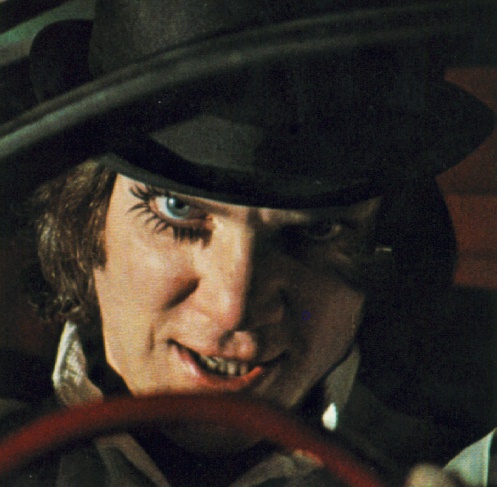
Wednesday, October 21, 2009

Is the Ludovico Technique Moral?


We are all aware of the fact that Alex Delarge, the main character in the film "A Clockwork Orange" experienced a horrific treatment while in prison called the Ludovico technique. This technique used classical conditioning to prevent Alex from commiting any acts of violence or rape. The scientists would inject Alex with a serum that would made him experience episodes of nausea and helplessness kind of like drowning. After he was injected they made him watch series of violence and rape. The result of the conditioning was that it rendered Alex unable to committ acts that he loved to committ. My question for you, which is the basis of my blog, is this: if we had the capability of providing prisoners in our prison system today with the Ludovico treatment would we? Because if you really think about it, the Ludovico technique is a microcosm of our prison system. Instead of associating acts of violence and rape with a feeling of helplessness, nausea, and drowning our prisoners associate their acts with shanks, cell bars, horrid beatings, and sodomy. Think about it this way what would you rather experience this:
or this:
Just an interesting thing to comtemplate I think.


Tuesday, October 20, 2009

Although not exactly what I envisioned, A Clockwork Orange displayed some of the psychological ideas we saw in class, including behavioral psychology. Alex, the protagonist, who rapes and kills for fun at the age of 16, is thrown into a brainwashing therapy which forces him to be sick while watching movie after movie of sexual assault and violence, even to the tracks of his beloved...

Ludvig van Beethoven. Similarly to the promises of John B. Watson in 1913 that investors could be forced into new habits through associations of certain objects with certain end results, the government in A Clockwork Orange try to force Alex's brain to associate rape and violence with his artificially induced sickness, promising a new era of peace and non-violence (narrated all in a first for movies!).

Monday, October 19, 2009

Conditioning of the Human Mind


In this video, Alex is shown being conditioned by being forced to watch gruesome scenes of violence, similar to what he had done before. By making him watch these videos until he says he's feeling sick forces him to associate violence with nausea. After this occurs, the drug begins to affect him. This drug causes severe paralysis and terror, which add to the negative associations of violence.
Alex's "treatment" pretty much turns him into one of Pavlov's dogs, in the sense that he responds predictably when confronted with conditioned events. Pavlov's dogs were trained to salivate in reaction to the stimulus of hearing a bell ring. This is because they "learned" that when they hear the bell they will receive food, so their bodies begin salivating. This is similar to how Alex is conditioned, but instead of being trained to a positive reaction, he is trained to be repelled from violence.
However, the mind is very plastic; it can be trained to act a certain way, and as easily as it was trained it can untie the connections. Just as Alex is "cured" from his treatment.

Associative Learning in "A Clockwork Orange"

In the movie "A Clockwork Orange", Alex saw the treatment in prison as an opportunity to escape the walls of the jail and back into society. Instead, the doctors made Alex a prisoner within himself. Once the doctors had control of Alex they conditioned him however they pleased by using associative learning. The doctors were able to train Alex to force a connection between nausea and any malicious activity. So, whenever Alex thought about violence or the "old in-out" he was immediately struck with a feeling of complete sickness  (http://www.youtube.com/watch?v=P-JAhY6eT3c )This is similar to Pavlov's experiments with dogs. Through a series of trials Pavlov trained dogs to salivate whenever a bell was sounded. He did this by associating a bell with eating. Whenever a bell was sounded the dogs would get food. Alex's treatment was much more harsh and included drugs that forced him to be sick. His whole life before the treatment was based in sex and violence and when they were taken away from him he had nothing else to turn to, not even his family.  

Classical Conditioning in Grandma's Birthday Cards AND A Clockwork Orange?

So, I was going home for fall break on Friday afternoon. On the plane, I happened to open up the American Way magazine and what do I see in the beginning of the AirMail section? "We love letters. Maybe it’s because our grandmas always used to tape a quarter to our birthday cards when we were little and we now have this Pavlovian thing going on." I thought this was hilarious, because we just learned about Pavlov in Psychology! However, if you're unfamiliar with Pavlov's idea of Classical Conditioning, which focuses on changing behavior, here's a simple breakdown using the example above:

BEFORE "CONDITIONING":


The Unconditioned Stimulus, or Pavlov's term for something that initiates an automatic response was the birthday cards in the mail, and the Unconditioned (automatic) Response was happiness because it always feels nice to get a card on your birthday, especially from your grandma.

DURING "CONDITIONING":
+Grandma sent them birthday cards in the mail with the Conditioned Stimulus, a quarter, so they were doubly happy whenever they received Grandma's birthday cards because of the quarter inside which they could use to buy something (a yummy piece of candy perhaps).

AFTER "CONDITIONING":


Now, after many years and many birthday cards from Grandma, every time they receive
any letter in the mail, the Conditioned Response of super happiness is initiated.
---------------------------------------------------------------------
In the famous movie A Clockwork Orange, a young man Alex leads a hedonistic lifestyle without regards for the rules of society, raping women and robbing homes. Eventually though, he is caught for murdering a woman, and is sent to jail. In order to shorten his sentence, Alex persuades his superiors to let him participate in an experimental trial called the Ludovico treatment. The underlying idea of the Ludovico treatment is Pavlov's classical conditioning.

BEFORE "CONDITIONING":
SEXUAL AND/OR VIOLENT IMPULSES
ALEX COMMITS SEXUAL AND/OR VIOLENT ACTS AND


Before Alex was jailed, when Alex was confronted with violent and sexual impulses, the Unconditioned Stimulus, he automatically followed through with these impulses and committed violent and sexual acts, the Unconditioned Response.
(The medicine used in the Ludovico Technique is also an Unconditioned Stimulus, and when someone is given this "medicine," their body will have an Unconditioned Response of extreme nausea.)

DURING "CONDITIONING":
+ IMAGES OF VIOLENCE AND RAPE
During the Ludovico treatment, Alex was repeatedly shown many images of violence and rape, which would usually create a sense of happiness in Alex. However, each time that he saw these images Alex was also given the medicine, the Conditioned Stimulus, which caused him to be almost physically paralyzed with an overall feeling of nauseousness.

AFTER "CONDITIONING":
SEXUAL AND OR VIOLENT IMPULSES


After the Ludovico treatment, when he was released into the real world, any time Alex got the urge to commit a violent or sexual act, he was immediately gripped with the extreme nauseousness even though he had long been without the Ludovico medicine. In other worlds, whenever Alex begins to have a sexual or violent impulse, his body begins to feel extremely nauseous, the Conditioned Response.

Oh, behave

"A Clockwork Orange" writer, Anthony Burgess, was not a big fan of Watson and Skinner's behaviorism ideas. In fact, he called Skinner's book, Beyond Freedom and Dignity, "one of the most dangerous books ever written." So does Alex's conditioning follow Skinner's "operant conditioning?" In my opinion, yes! The reward and consequence practice is strongly used in the movie, as Alex is punished every time he wants to be violent or engage in sexual acts. This video shows one of Skinner's experiments that conditions with reward instead of punishment, but still is similar to Alex's conditioning http://www.youtube.com/watch?v=I_ctJqjlrHA Because Burgess did not agree with the ideas behind behaviorism, Alex's "mind" overcomes his conditioning in the end, thus going against the principles of Skinner and Watson. So, the movie is basically criticizing behavioral psychology and the results are a disturbing and intriguing look into the human psyche.

Sex, Drugs, and Classical Conditioning


The movie, A Clockwork Orange, is a prime example of Ivan Pavlov's idea of classical conditioning. Classical conditioning is a form of learning in which a neutral stimulus becomes associated with a meaningful stimulus and acquires the capacity to induce a similar response.

The movie focuses on a 15-year-old boy named Alex DeLarge who was the self-proclaimed leader of a small gang in England. He is convicted of the murder of a cat-woman. He is sentenced to 14 years in prison.

After 2 years he voluntarily subjects himself to a experimental treatment called the Ludovico technique that would allow him to leave jail within a fortnight. The Ludovico technique is an example of classical conditioning.


In Alex's case, doctors subjected him to a series of violent images with Beethoven's 9th Symphony playing in the background. He is given drugs that cause him to have a near-death experience. The combination of the images, drugs, and music cause him to get sick whenever he hears Beethoven's 9th or tries to take part in any violent or sexual act.


In the eyes of the doctors, the treatment worked and Alex is cured of his violent behaviors. But in reality, Alex is no longer able to defend himself or make logical decisions in his life when violence may be involved.

For more information, please watch this video on classical conditioning.

Is Free Will Really Lost with Behavior Change?

What intrigues me most about A Clockwork Orange is the idea that free will is destroyed with classical and/or emotional conditioning. Before Alex received the treatment he found pleasure in violence and rape. Then, during conditioning, he was injected with a serum that made him sick while he watched violence. The result was that he felt sick around violence. Does that change make Alex lose his humanity?

Before Treatment Picture>

Behavioral Approach: Associating violent acts that Alex carries out with bad feelings is a step that he missed while he was developing. Completing the behavior change was necessary for Alex to be a contributing member of society.

Humanistic Approach: Alex’s core being was disturbed when he was physically no longer able to make the choices he wanted to. He had lost a part that makes him human.

Cognitive Approach: Alex is no less human after he receives treatment. It is simply another program installed in Alex that doesn’t allow his violent behavior to be expressed.

Psychodynamic Approach: Alex’s sexual and aggressive impulses are not repressed as much as most members in society. These biological instincts are put under control after the treatment matching him with the rest of society.

After Treatment Picture >

Everyone is predisposed to certain behavioral tendencies and Alex is no exception. Instead of being predisposed to societal norms he in predisposed to violence. However conditioning him against the violent behaviors does not make him a “clockwork orange” because he still maintains humanity. This is proven at the end when he still breaks away from the behavioral changes he had experienced through his treatment.


Alex and Beethoven VS Classical Conditioning


In the disturbing film, The Clockwork Orange, teenager Alex DeLarge (shown above) is sent to jail for assaulting multiple women. While serving his time, he is told that if he participated in som experiments he would "be fixed forever" and would end his sentence early. Scientists perform cruel and unusual actions on him mentally and physically. They put Alex through classical conditioning.
These scientists believed that with this treatment, Alex will realize that what
he had done is wrong. They first strapped him to a chair and so that he could not move. While in
the chair, they pried his eyelids open with clamps so that he was completely unable to move
them or close them. During the time when he was trapped, the scientists played clips of the Nazi's
performing acts of hate. They also showed a movie of a gang attacking and raping a young girl,
the same crime Alex and his gang executed. These videos drove Alex mad and lead him to cringing
every time he would see these images.
Pavlov first introduced the concept of classical conditioning. One of his most
famous studies involved using dogs as tests subjects. Pavlov would would ring a bell and,
corresponding with the meat, he proved that the dogs would salivate to the sound
of the bell. In relationship to Clockwork Orange, Alex would now wince at the sight of
these videos and what they represent.


6 Double5 321

"A Clockwork Orange", a film by Stanley Kubrick, portrays Ivan Pavlov's classical conditioning. Alex, a young lad who is sentenced to prison for rape and murder, undergoes The Ludovico Technique.


The Ludovico Technique is a method that shows Alex different explicit clips such as severe beating, rape, and Nazis. Before watching the films, Alex is given a drug that causes death like paralysis with a deep feeling of horror and helplessness. When Alex watches the clips he begins to feel nauseous and anxious.

The treatment conditions Alex to feel nauseous and helpless whenever he is about to commit a violent or sexual act. Classical music was played in the background of the movie clips so whenever he hears classical music he begins to feel nauseous becase he associated the music with acts of violence.

"The subject is impelled towards the good by paradoxically being impelled to the evil." In other words, in order to be good, Alex must first witness the moral wickedness. "The intention to act violently is accompanied by strong feelings of physical distress." In other words, after treatment, whenever Alex feels a violent rage coming on he instantly feels physical distress which stops him from any temptation.

Skinner's Skills Scare Scally

B.F. Skinner a normal old man. Father, Husband, major contributor to the scientific field of psychology.... Or a Monster whos practices made the tormenting of souls easier.

-The Summary-
Intro.: In the 1971's A Clockwork Orange a violent youth Alex DeLarge (Inmate"6655321")
was convicted of Rape and Murder Charges. Alex was young an through his youth and charisima became a favorite of the jail's Priest. He used his natural charisima to find out and become a candidate for a new expirment. The experiment, as Alex heard it, was suppose to get you out of Jail ,quick, and keep you out. Agianst the suggestions of the Priest Alex gets himself noticed by the Minister in charge of the program , and selected immediatley.
The Background: Overflow in jails is a serious problem, it was in the 50's in America that the CIA started Project MKULTRA. This was a porject that was seeking ways to Control minds period. It wasn't uncovered until the 70's. The Author of the Novel A Clockwork Orange was Anthony Burgess. Burgess disapproved of Watson and Skinner's theories of Behaviourism. Dr. Ludovico's experment is akin to the acual CIA project, but the movie is a message to beware using mind control to achieve Utopian Society.
The Experiment: Upon arriving at the Medial center Alex was prepared to watch a Movie. He was injected with Chemical "114", which he was told was to boost his nutrition. He was brought to a cinema setting were he was straped in to a chair, with straight jacket. His eyes were also kept apart with forceps. He was forced to watch scenes with violence and rape. While watching the scenes Chemical "114" made him violently (pun inteded) sick. So Violent Alex who enjoyed violent scenes began to become disgusted by them. in the 3rd exepriment Beethoven's 9th Symphony, 4th Movment, was played in the background. This horrified Alex.
Being intelligent he had guessed that they were conditioining to make him feel sick toward violent sitiautions. He did no want to be sick everytme he heard Beethoven. Through protest the expirment was completed leaving Alex incapable of making moral based chocies, and instead mad diblatingly sick when confronted by violence or sex.


-Learning Psychology-
Clssical Conditioning- is the pairing of a neutral stimiuls with a provoking stimiulus. The provoking stimulus causes a response where as the neutral stimulus causes no visible or apparent response. When these stimuli are paired together repetedly association occurs. with association the introduction of the neutral stimilus causes a response similiar the provoking stimiulus.

Unconditioned Stimiuls = provoking stimulus UCS Unconditioned Response = reaction to UCR
Conditioned Stimulus = neutral stimulus Conditioned Response= reaction to CR

In the movie Alex is given chemical "114" (UCS) + he watches violent/sexual movies (CS)
--> When he sees violence, or feels violent, he becomes/feels sick(UCR)
&
By the 3rd experiment Beethoven is played(CS) + Chemical "114" (UCS) --> When he hears Beethoven He feels sick and paralyzed.

-Reaction-
Know as the movie and the Authors intent would suggest Skinner's methods of Classical Conditioing are horrific and injust. (FALSE)
Ivan Pavlov is the originator of Classical Conditioning. Where as Skinner did Operant Conditioning. The Movie was made as to speak out agianst the horros of science and it use to control humans. It generalized two figures in the world of psychology and belittled it to Mad-Man-like practices. The movie made religion as the savior of man and science as the twister of souls. In the movie the priest warns Alex of the dangers of the experiment, but Alex goes agianst his advice. When the scientest presents Alex to the audience it is the priest who speaks out agianst the demonstration. The preist cites the fact that Alex is know not in control of his own body inable to use the gift God gave man. From a political view the movie mad science into the big bad wolf out to mentaly neuter the troubled people of the world.


"I am going to be sick!"


In Stanley Kubrick's 1971 psychological film, A Clockwork Orange, a teenager by the name of Alex DeLarge experiences classical conditioning after being in jail. Alex was originally sentenced to 40 years in prison for the murder of a woman. He admitted to not only this crime, but many others violent crimes that he had committed. Alex was given an incentive that if he were to try a new treatment that would "fix him forever" he would be released from jail once the treatment was completed. This treatment was an example of classical conditioning.

Classical conditioning was introduced to the world of psychology by Pavlov and his experiment with dogs and getting them to salivate by the sound of a bell. This method of behavior is a response to a unconditioned stimuli (something that enables a certain behavior) which results in a unconditioned response (a common, natural response to the stimuli). Then the subject is exposed to a neutral stimulus (a common "thing" that does not create any response, it is neutral). The conditioning part of the behavior then occurs. The subject exposed to the neutral and the unconditioned stimulus simultaneously which results in the same unconditioned response. After conditioning is completed, the subject will have the same response to the new conditioned stimulus as it had to the unconditioned stimulus. Therefore, it creates a conditioned response to a certain stimulus. Using this method, successfully Pavlov trained his dogs to salivate to the sound of a bell being rung.

In A Clockwork Orange, Alex experiences the same type of behavior change, except his stimuli and response are as follows:
Unconditioned Stimulus- vulnerable women, old men, unlocked homes
Unconditioned Response- violence, rape, stealing
Neutral Stimulus- feeling sick
Conditioned Stimulus- violence
Conditioned Response- feeling sick when he sees violence

The following is a video of Alex as he is experiencing the conditioning stage of classical conditioning. http://www.youtube.com/watch?v=_NMzepSePD4&feature=related

In the end of the classical conditioning process, Alex felt sick when he saw or experienced any sort of violence. Therefore, the classical conditioning performed on Alex DeLarge was a success!

*Reprogramming Alex*

In the movie, A Clockwork Orange, the main character and narrator, Alex De Large, becomes subject to the processes of Classical Conditioning.  This type of conditioning is a process of behavior modification by which a subject comes to respond in a desired manner to a previously neutral stimulus that has been repeatedly presented along with an unconditioned stimulus that elicits the desired response. The Doctors at the psychiatric hospital conditioned Alex, who previously received a neutral stimulus from violent actions such as rape or other physical attacks, to pair violence with nausea.   To condition him in this way, the Doctors gave Alex medicine that made him nauseous right before forcing him to watch videos of rape, physical brutality, and Nazi violence.  Therefore, Alex felt nauseous while watching these films. 

To further understand Classical Conditioning, go to http://www.youtube.com/watch?v=hhqumfpxuzI 

In my opinion, Classical Conditioning can also be referred to as a reprogramming system of behavioral processes that forces the subject to respond to different stimulus in certain ways.  In Ivan Pavlov's example, he forced (or conditioned) his dogs to respond to bells by salivating and expecting to consume food.  Similarly, every time Alex wanted to lash out violently, he began to feel nauseous because he was programmed to do so by the Doctors.  

Important Movie Quotes:

“You needn't take it any further, sir. You've proved to me that all this ultra-violence and killing is wrong, wrong, and terribly wrong. I've learned me lesson, sir. I've seen now what I've never seen before. I'm cured! Praise god!” -Alex

“Violence is a very horrible thing! That’s what you’re learning now. Your body is learning it.”  -The Nurse

These quotes are important because they show how both Alex and the doctors respond to the process of Classical Conditioning.


Sunday, October 18, 2009

Evoking Emotions

In the movie A Clockwork Orange, the narrator, Alexander DeLarge is sent to jail for murdering a woman. In order to get out earlier than his sentenced 40 years, he agrees to subject himself to a scientific study that manages to keep prisoners out of jail.

This treatment can be described as Emotional Conditioning. It is different from Classical Conditioning because in classical conditioning, an organism learns to associate one stimulus with another, while in Emotional Conditional an emotional response is a result of conditioning. So, for example, a fear can be learned. In A Clockwork Orange, Alex is forced to watch violent scenes.
After being exposed to this experiment, Alex becomes sick whenever he tries to do wrong, such as hitting another person. This experiment is similar to John B. Watson’s experiment with baby Albert. Both experiments show how emotional conditioning affects those subjected to certain situations and stimuli.


Stanley's Beef with Beethoven


Stanley Kubrick serves as a true "guinea pig" in A Clockwork Orange.  Beginning as a wayward teenager who is tormented by his malevolent thoughts to rape and kill innocent people with his colt, Stanley is imprisoned and participates in an experiment entitled the “Ludovico Technique” while serving his time.  This therapeutic treatment engrains violent images to reverse negative thoughts and actions.  Beethoven’s 9th streams in the background of these daily treatments for the two week period as a control, but this was ironically Stanley’s favorite symphony before he went on his tangent.  Therefore, the music evoked the evil thoughts that incited the murder and rape and ultimately brought him back to his previous state before the treatment took place.  The psychological principle that explains this reaction (or lack thereof) to the treatment is called classical conditioning.  Beethoven’s music was the stimuli because it incited a reaction (unconditioned stimulus).  Beethoven’s symphonies are soothing to most people, but Stanley has a previous association with the music (murder and rape) so it makes him anxious (unconditioned response).  The music triggered his memory of murder and rape because he has listened to it before he committed these crimes (conditioned stimulus).  In the end he was back to his original demented state and history of psychopathy (conditioned response) because the music reminded him of his past and the treatment did nothing. 
Specifically read the "Music and Moods" portion of the article.
This video is Stanley listening to Beethoven before the crimes.